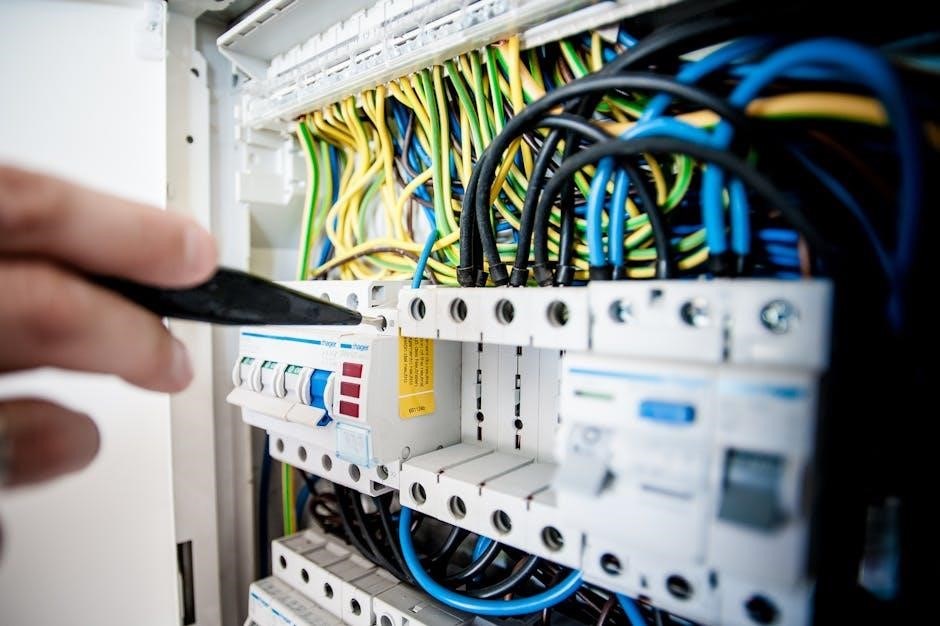
Electrical professionals often question circuit breaker selection with surge protectors, while manufacturers like Eaton innovate with mining-specific W-VACiMB breakers.
Common experiences involve resetting GFCIs, yet large breakers at facilities protect equipment with diverse configurations and voltage ratings.
Siemens addresses steel industry demands with refined medium-voltage breakers, highlighting the surprising frequency of incorrect breaker specifications by engineers.
What is a Circuit Breaker?
A circuit breaker is fundamentally a safety device designed to protect electrical circuits from damage caused by excess current, typically resulting from overload or short circuits. Unlike fuses, which melt and require replacement, circuit breakers can be reset after tripping, offering a reusable protective solution. The core function revolves around interrupting the flow of electricity when a fault is detected, preventing overheating and potential fire hazards.
The selection process, as highlighted by industry discussions, can be surprisingly complex, even for experienced engineers. Considerations extend beyond simply matching voltage and current ratings; compatibility with surge protectors and specific application needs, like those in mining environments with Eaton’s W-VACiMB, are crucial. Understanding the different types of circuit breakers – a topic often found in detailed PDFs – is paramount for effective protection.
Why are Circuit Breakers Important?
Circuit breakers are absolutely vital for ensuring electrical safety and preventing catastrophic damage to equipment and infrastructure. They act as the first line of defense against potentially hazardous conditions like overloads and short circuits, mitigating the risk of fires and electrical shocks. The ability to quickly interrupt current flow, unlike single-use fuses, minimizes downtime and allows for swift restoration of power after a fault is addressed.
As evidenced by common experiences with GFCIs and the sophisticated needs of industrial facilities, proper breaker selection is critical. Resources like detailed ‘types of circuit breakers’ PDFs emphasize the importance of understanding various breaker technologies to match specific application requirements, from residential kitchens to demanding mining operations utilizing specialized breakers like those from Eaton.

Types of Circuit Breakers: A Comprehensive Overview
Diverse breakers—MCBs, MCCBs, ACBs, GFCIs, AFCIs, and medium/low voltage options—protect systems, as detailed in ‘types of circuit breakers’ PDFs.
Miniature Circuit Breakers (MCBs)
Miniature Circuit Breakers (MCBs) are widely utilized for protecting domestic, commercial, and industrial electrical circuits against overloads and short circuits. These devices are typically employed in single-phase applications, offering a compact and cost-effective solution for circuit protection. ‘Types of circuit breakers’ PDFs often detail MCB characteristics, including their tripping curves – B, C, and D – which dictate their response to different fault current magnitudes.
MCBs operate through thermal or magnetic mechanisms, or a combination of both, to interrupt the circuit when a fault is detected. Their modular design allows for easy installation and replacement within a distribution board. Understanding MCB ratings, such as current capacity and breaking capacity, is crucial for selecting the appropriate breaker for a specific application, as highlighted in comprehensive guides.
Molded Case Circuit Breakers (MCCBs)
Molded Case Circuit Breakers (MCCBs) represent a robust solution for medium to high current applications, frequently found in commercial and industrial settings. ‘Types of circuit breakers’ PDFs emphasize that MCCBs offer greater interrupting capacities compared to MCBs, making them suitable for protecting larger electrical systems. They are designed to handle both overload and short-circuit conditions, providing comprehensive protection.
MCCBs incorporate thermal and magnetic tripping mechanisms, often with adjustable settings to fine-tune their response. Their molded plastic casing provides insulation and mechanical protection. These breakers come in various frame sizes and configurations, allowing for flexibility in system design. Selecting the correct MCCB involves careful consideration of voltage ratings, current ratings, and interrupting capacity, as detailed in technical documentation.
Air Circuit Breakers (ACBs)
Air Circuit Breakers (ACBs) are typically employed for high-current and high-voltage applications, commonly found in large industrial facilities and power distribution systems. ‘Types of circuit breakers’ PDFs highlight ACBs’ ability to interrupt very high fault currents, exceeding the capabilities of MCCBs. They utilize air as the insulating medium, hence the name, and employ sophisticated arc-quenching techniques.
ACBs often feature electronic trip units offering advanced protection functions like adjustable time-current characteristics and earth fault protection. Their robust construction and high interrupting capacity make them ideal for protecting critical equipment and ensuring system reliability. Proper selection, guided by technical specifications, is crucial for optimal performance and safety within the electrical infrastructure.
Specific Circuit Breaker Types & Applications
GFCIs frequently trip in homes, while specialized breakers like the W-VACiMB serve mining, and Siemens refines breakers for steel industries.
Ground Fault Circuit Interrupters (GFCIs)
Many individuals primarily associate circuit breakers with the frequent resetting of Ground Fault Circuit Interrupters, or GFCIs, commonly found in kitchens and bathrooms. These devices are crucial safety components designed to quickly interrupt electrical circuits when detecting a ground fault – a leakage of current to ground.
This rapid response minimizes the risk of severe electrical shock. GFCIs are particularly important in damp or wet locations where the chance of ground faults is elevated. While seemingly simple in function, GFCIs represent a vital layer of protection within residential and commercial electrical systems, safeguarding people from potentially life-threatening hazards. Their consistent, though sometimes inconvenient, tripping underscores their diligent operation.
Arc Fault Circuit Interrupters (AFCIs)
While often overshadowed by the familiarity of Ground Fault Circuit Interrupters (GFCIs), Arc Fault Circuit Interrupters (AFCIs) represent a significant advancement in electrical safety technology. AFCIs are designed to detect dangerous arc faults – unintended electrical discharges – that can ignite fires.
Unlike GFCIs which address shock hazards, AFCIs target fire prevention. These arc faults can occur due to damaged wiring, loose connections, or faulty appliances. AFCIs differentiate between normal arcing (like when a switch is turned on) and dangerous arcing, interrupting the circuit only when a hazardous condition is present. Their inclusion in modern electrical codes reflects a growing emphasis on proactive fire safety measures within buildings.
Medium Voltage Vacuum Circuit Breakers
Medium Voltage Vacuum Circuit Breakers (VACBs) are crucial components in industrial and commercial power systems, designed for applications ranging from 3.3kV to 33kV. These breakers utilize a vacuum interrupter to extinguish the arc created when interrupting current flow, offering a clean and reliable switching solution.
Eaton’s W-VACiMB is a recent example, specifically engineered for the demanding conditions of mining applications. VACBs are favored for their compact size, low maintenance requirements, and fast operating speeds. Siemens also refines medium-voltage breakers for industries like steel production, demonstrating their adaptability. They represent a robust choice for protecting valuable electrical equipment.
Low Voltage Circuit Breakers
Low Voltage Circuit Breakers (LVCBs) are the most commonly encountered type, protecting circuits typically up to 600V. They are essential for safeguarding residential, commercial, and light industrial installations from overcurrents and short circuits. Many individuals’ primary experience with circuit breakers involves resetting Ground Fault Circuit Interrupters (GFCIs), a specific type of LVCB.
These breakers come in various configurations, sizes, and ratings to suit diverse applications. Engineers sometimes incorrectly specify breakers, highlighting the importance of proper selection. LVCBs are fundamental to electrical safety, preventing damage to equipment and reducing the risk of electrical fires within buildings and facilities.

Circuit Breaker Operation & Mechanisms
Circuit breakers utilize thermal, magnetic, or electro-thermal mechanisms to interrupt faults, protecting electrical systems and equipment from damage and potential hazards.
Thermal Circuit Breakers
Thermal circuit breakers operate on a simple principle: excessive current causes a bimetallic strip to heat and bend, triggering the breaker to trip. This bending action mechanically releases the latch, interrupting the circuit. They are particularly effective at protecting against sustained overloads, like those caused by too many appliances running on a single circuit.
These breakers respond to the total heat generated by the current, making them ideal for situations where the overload persists for a period. However, they are generally slower to respond to sudden, high-magnitude short circuits compared to magnetic breakers. The time it takes to trip is inversely proportional to the magnitude of the overload – larger overloads trip faster. This characteristic makes them suitable for applications where nuisance tripping due to temporary surges needs to be minimized.
Magnetic Circuit Breakers
Magnetic circuit breakers utilize an electromagnet to detect overcurrents. When current exceeds the breaker’s rating, the magnetic field generated becomes strong enough to pull a lever, instantly tripping the breaker. This provides very rapid response to short circuits – far faster than thermal breakers – protecting equipment from damaging fault currents.
However, magnetic breakers are less sensitive to sustained overloads. They primarily react to the instantaneous magnitude of the current, not the accumulated heat. Consequently, they might not trip quickly enough for lower-level, prolonged overloads. Often, these breakers feature a fixed trip curve, meaning the tripping point is consistent regardless of duration. This makes them excellent for protecting against sudden, catastrophic failures, but less ideal for preventing gradual damage from overheating.
Electro-Thermal Circuit Breakers
Electro-thermal circuit breakers combine both thermal and magnetic trip mechanisms, offering comprehensive protection. They employ a bimetallic strip that heats up with sustained overcurrents, eventually causing the breaker to trip – similar to thermal breakers. Simultaneously, a magnetic element responds to high-fault currents, providing rapid interruption like magnetic-only types.
This dual functionality delivers a more refined protection profile. The thermal component handles prolonged overloads, preventing overheating, while the magnetic component swiftly addresses short circuits, minimizing damage. The trip curves are often adjustable, allowing customization for specific application needs. This combination makes electro-thermal breakers versatile and suitable for a wide range of electrical systems, offering robust and reliable performance.

Circuit Breaker Ratings & Specifications
Breakers come in diverse shapes, sizes, and voltage ratings, primarily designed to protect electrical equipment at industrial and commercial facilities effectively.
Voltage Ratings
Circuit breaker voltage ratings are crucial specifications, defining the maximum voltage a breaker can safely interrupt. These ratings directly correlate to the system voltage where the breaker will be installed, ensuring proper protection and preventing damage. Industrial and commercial facilities utilize breakers with a wide range of voltage ratings, reflecting the diversity of their electrical systems.
Understanding these ratings is paramount for engineers and electrical professionals. Selecting a breaker with an insufficient voltage rating can lead to catastrophic failure, while an excessively high rating might compromise protective functions. Manufacturers clearly label voltage ratings on breakers, often expressed in kilovolts (kV) or volts (V), facilitating correct application. Proper voltage rating selection is fundamental to electrical safety and system reliability.
Current Ratings
Circuit breaker current ratings indicate the maximum continuous current the breaker can carry without overheating and potentially failing. This rating, typically expressed in amperes (A), is vital for matching the breaker to the expected load. Selecting a breaker with a current rating lower than the load’s demand will result in nuisance tripping, disrupting operations. Conversely, a significantly higher rating may not provide adequate protection during fault conditions.
Large breakers found in industrial settings demonstrate a broad spectrum of current ratings, accommodating diverse equipment needs. Engineers must carefully consider the load characteristics and potential fault currents when specifying current ratings, ensuring both reliable operation and effective protection. Proper current rating selection is essential for maintaining electrical system integrity.
Interrupting Capacity
Interrupting capacity, measured in kiloamperes (kA), defines the maximum fault current a circuit breaker can safely interrupt. This is a critical specification, as exceeding this capacity can lead to catastrophic breaker failure, potentially causing fires or explosions. Larger industrial and commercial facilities utilize breakers with significantly higher interrupting capacities to handle substantial fault currents.
Engineers frequently underestimate the importance of selecting the correct interrupting capacity, leading to potentially dangerous situations. The interrupting capacity must be greater than the maximum prospective short-circuit current at the breaker’s location. Proper assessment and specification of interrupting capacity are paramount for ensuring electrical system safety and reliability.

Advanced Circuit Breaker Technologies
Innovations include solid-state and smart circuit breakers, offering enhanced protection and integration capabilities, while digital breakers promise further advancements.
Solid State Circuit Breakers
Solid State Circuit Breakers (SSCBs) represent a significant departure from traditional electromechanical designs, utilizing semiconductor technology for switching and protection. Unlike their mechanical counterparts, SSCBs offer incredibly fast operation speeds, responding to overcurrents and faults in microseconds – a crucial advantage in sensitive electronic systems.
This rapid response minimizes stress on protected equipment and reduces the let-through energy during fault events. SSCBs also boast enhanced reliability due to the absence of moving parts, leading to reduced maintenance requirements and extended operational lifespans. Furthermore, they provide precise current limiting and arc-free interruption, enhancing safety and system stability.
While traditionally more expensive than conventional breakers, the cost of SSCBs is decreasing, making them increasingly viable for a wider range of applications, particularly in data centers, renewable energy systems, and critical infrastructure where reliability and speed are paramount.
Smart Circuit Breakers
Smart Circuit Breakers (SCBs) integrate advanced monitoring, communication, and control capabilities into traditional circuit breaker functionality. These intelligent devices go beyond simple trip functions, providing real-time data on current, voltage, power consumption, and even temperature; This data is often accessible remotely via network connectivity, enabling predictive maintenance and proactive fault detection.
SCBs can be programmed with customizable trip curves and settings, allowing for optimized protection tailored to specific loads. They often feature self-diagnostic capabilities, alerting operators to potential issues before they escalate into failures. Integration with Building Management Systems (BMS) and smart grids is a key feature, enabling automated load shedding and improved energy management.
The enhanced visibility and control offered by SCBs contribute to increased system reliability, reduced downtime, and improved overall energy efficiency.
Circuit Breaker Standards & Compliance
Circuit breakers must adhere to rigorous standards like UL and IEC, ensuring safety and performance. Compliance guarantees protection for equipment and personnel.
UL Standards
Underwriters Laboratories (UL) plays a crucial role in establishing safety standards for circuit breakers used throughout North America and increasingly globally. UL listing signifies that a circuit breaker has been rigorously tested and meets nationally recognized safety requirements, protecting against fire hazards and electrical shock.
These standards cover various aspects, including construction, performance under fault conditions, and interrupting ratings. Different UL standards apply to different types of circuit breakers, such as UL 489 for molded case circuit breakers and UL 1077 for supplemental protectors. Compliance with UL standards isn’t merely a recommendation; it’s often a legal requirement for installation and use in many jurisdictions.
Manufacturers submit their products to UL for testing, and those that pass receive the UL mark, providing assurance to consumers and authorities that the breaker is safe and reliable. Regular audits and follow-up inspections ensure continued compliance.
IEC Standards
The International Electrotechnical Commission (IEC) develops and publishes global standards for electrical equipment, including circuit breakers. Unlike UL standards primarily used in North America, IEC standards are widely adopted internationally, ensuring interoperability and safety across borders. IEC 60947 is a key standard encompassing low-voltage switchgear and controlgear, including various types of circuit breakers.
This standard details performance characteristics, testing procedures, and safety requirements. Specific IEC standards address different breaker types, like IEC 60898 for MCBs and IEC 60947-2 for MCCBs. Adherence to IEC standards demonstrates a manufacturer’s commitment to quality and safety on a global scale.
Many countries mandate IEC compliance for electrical products sold within their territories, fostering a consistent level of safety and performance worldwide.

Circuit Breaker Maintenance & Troubleshooting
Regular inspection and preventative maintenance are crucial for reliable operation, addressing common issues like tripped GFCIs and ensuring optimal protection.
Common Issues & Solutions
Frequent tripping is a prevalent issue, often stemming from overloaded circuits or short circuits demanding immediate attention. Resetting a tripped Ground Fault Circuit Interrupter (GFCI) is a common household task, but repeated trips signal a deeper problem requiring investigation.
Loose connections can cause overheating and intermittent power, necessitating tightening of all terminals. Corrosion, particularly in industrial settings, degrades contact points, reducing efficiency and potentially leading to failure; cleaning or replacement is vital.
Mechanical failures, such as a stuck breaker handle, require professional assessment and potential replacement. Incorrect breaker specification, as noted by engineers, can lead to inadequate protection, emphasizing the importance of proper selection during installation and upgrades.
Preventative Maintenance
Regular visual inspections are crucial, checking for signs of damage, corrosion, or overheating. Tightening connections annually prevents loose wiring, a common cause of intermittent power and potential hazards, especially in industrial facilities with large circuit breakers.
Periodic testing, using appropriate testing equipment, verifies proper operation and responsiveness to fault conditions. Dust and debris accumulation can impede performance, necessitating cleaning, particularly in mining applications where specialized breakers like Eaton’s W-VACiMB are deployed.
Maintaining accurate records of inspections and tests facilitates tracking breaker health and predicting potential failures. Proactive maintenance, guided by standards and compliance regulations, minimizes downtime and ensures reliable electrical system protection.

Future Trends in Circuit Breaker Technology
Digital circuit breakers and integration with smart grids represent emerging advancements, promising enhanced monitoring, control, and responsiveness within electrical systems.
Digital Circuit Breakers
The evolution of circuit breaker technology is rapidly advancing towards digital solutions, representing a significant departure from traditional electromechanical designs. These innovative devices integrate sophisticated sensors, microprocessors, and communication capabilities, enabling real-time monitoring of electrical parameters like current, voltage, and temperature with unprecedented precision.
Digital circuit breakers offer enhanced protection features, including advanced algorithms for arc fault detection, ground fault identification, and overload prevention. Their ability to communicate data wirelessly facilitates remote control, diagnostics, and predictive maintenance, optimizing system reliability and minimizing downtime. Furthermore, they seamlessly integrate into smart grid infrastructures, contributing to improved grid stability and efficiency.
This technology allows for customizable protection settings, adapting to specific load requirements and enhancing overall system safety. The future promises even more intelligent digital breakers with self-learning capabilities and advanced cybersecurity features.
Integration with Smart Grids
The integration of advanced circuit breakers, particularly digital and smart models, is crucial for the functionality and reliability of modern smart grids. These grids demand responsive and intelligent protection devices capable of handling bidirectional power flow, distributed generation, and fluctuating renewable energy sources.
Circuit breakers equipped with communication capabilities enable real-time data exchange with grid management systems, facilitating automated fault detection, isolation, and service restoration. This enhances grid resilience and minimizes outage durations. Furthermore, they support advanced grid functionalities like demand response and voltage optimization.
Seamless integration requires adherence to standardized communication protocols and cybersecurity measures, ensuring secure and reliable operation within the complex smart grid ecosystem. The future of power distribution relies heavily on these interconnected, intelligent protection systems.